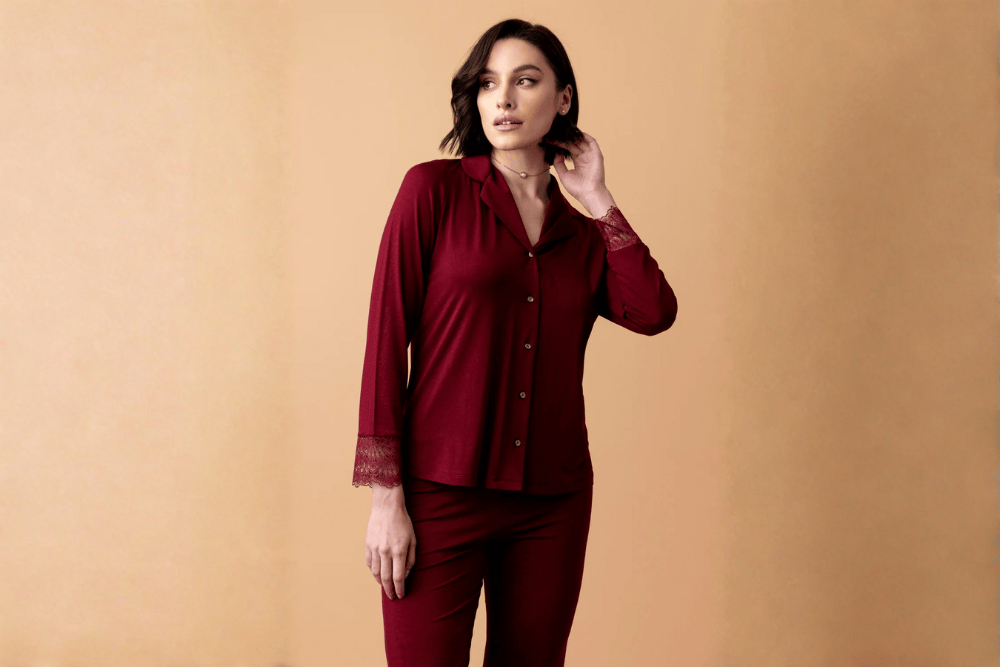
Button-up pajamas can look elegant and "catalog-worthy"—until they start to spread at the bust, pull at the back, or tighten at the waist as you move. And it's not just about "buttons being so charming," it's about the fit: the right amount of room in the waistband, the right construction of the top, and the right size (especially if you have a larger bust or prefer a looser fit). In this guide, I'll show you how to quickly assess whether pajamas are cut for your figure, how to measure key areas, and what tricks ensure buttons stay in place—without fuss, discomfort, or having to readjust every five minutes.
- How to choose the right size of button-down pajamas so that they don't stretch out around the bust
- How much structural ease do you need for a larger bust?
- The most common errors when measuring circumference
- Cut, fabrics and knits – what influences button separation?
- The difference between satin and viscose satin
- How to check fit before buying and after trying on
- Movement test: raising arms and twisting the trunk
- When you hesitate between two sizes
How to choose the right size of button-down pajamas so that they don't stretch out around the bust
Loose buttons are almost always a sign that the pajama top is too tight around the bust – even if everything seems fine around the waist or shoulders. For button-up styles, it's crucial to have enough structural slack , allowing the fabric and knit to move freely during movement and breathing. If the fabric between the buttons stretches slightly even when standing, the effect will be even more noticeable when changing positions at night.
When choosing a size, pay attention to three elements:
- bust circumference – measured at the widest point, without squeezing the measuring tape,
- the difference between the bust and waist circumference – the greater the difference, the more important the cut is,
- button arrangement – the larger the bust, the more important their proper spacing is.
If you're between two sizes and have a fuller bust, the larger size is a safer choice—especially for more fitted styles. Well-tailored women's button-up pajamas should flow gently around the figure, not be tight. High-quality fabrics and knits—especially those with a predominance of viscose—drape beautifully, but they need room to maintain an elegant line without stretching between the buttons.
It's also worth remembering that the size on the label is one thing, but the actual fit is another. In well-designed sleepwear, comfort doesn't mean a baggy cut, but a well-thought-out construction that takes into account a woman's proportions and allows you to feel comfortable all night long.
How much structural ease do you need for a larger bust?
With a fuller bust, the problem of loose buttons isn't a result of "too much bust," but rather of too little allowance in the bust and insufficient space in the front . A button-up pajama top should have a few centimeters of slack above the actual bust circumference—so that the fabric doesn't stretch to the breaking point even when standing.
How to evaluate this in practice? Here are some rough estimates:
- small bust (A–B) – minimum 3–4 cm of looseness in the circumference,
- medium bust (C–D) – about 4–6 cm of looseness,
- larger bust (E+) – up to 6–8 cm of allowance, especially in more fitted styles.
This is especially important in straight-cut styles without darts to shape the front. If horizontal "slits" appear between the buttons, it's a sign that there's a lack of space in this area. High-quality fabrics and knits – especially those with a predominance of viscose – drape beautifully, but they shouldn't be stretched to fit your figure .
In well-designed collections, such as fashionable women's pajamas , the construction takes into account the natural differences in proportions of the female figure. This ensures that even with larger busts, buttons remain in place, and the front line looks smooth and elegant – without straining or distorting the pattern.
If you also care about greater thermal comfort and freedom of movement, it is worth considering models with longer sleeves and a more classic cut, which provide not only aesthetics but also real comfort while sleeping .
The most common errors when measuring circumference
A poorly chosen size often starts with... a poor measurement. If a button-up pajama is loose at the bust, even though it theoretically "should fit," the problem may lie in the measurement method. Even a difference of 2-3 cm can be significant in front-fastening styles, where every centimeter of slack affects whether the buttons stay on .
The first mistake is measuring your bust in a bra that's too soft or too stiff, which alters the natural shape of your breasts. It's best to measure in a light, well-fitting bra, or without one at all, so that the measurement is as close as possible to your actual sleeping position. The second common mistake is tightening the measuring tape too tightly. The tape should be snug but not constricting, otherwise you'll end up choosing a "snug fit."
It's also worth remembering that the bust measurement should be the starting point , not the waist measurement. In button-up pajamas, the most important thing is the space at the front – the waist can be slightly looser, but the lack of space at the button height will always be noticeable. This is especially true for women's long-sleeved pajamas , where the extra sleeve length and front construction require even greater precision in the fit.
It's also good practice to compare your measurements with the manufacturer's chart, instead of relying solely on the standard S, M, or L designations. In collections created with attention to quality and construction, the differences between sizes are carefully considered – thanks to this, the nightwear not only looks aesthetically pleasing, but above all, maintains comfort and a slim fit even when moving .
Cut, fabrics and knits – what influences button separation?
Whether or not buttons come loose depends not only on size, but also on the design of the front and how the fabric works . Two pajamas with the same bust size can behave completely differently: one will fit smoothly, while the other will start to "open" between the buttons with every arm movement.
Most often, this is determined by specific construction elements and the choice of fabric and knitwear:
- fastening line – if the pleat is too soft or narrow, the material bends more easily and creates gaps,
- button spacing – larger spaces look light, but with a fuller bust they can cause “windows”,
- extra space in the front – styles with slightly more space in the front "hold" the clasp better,
- the arrangement of the shoulders and armpits – when the top is too narrow in the shoulders, the whole thing pulls the front and pushes the buttons apart,
- softness and slipperiness of the material – some materials slide more easily, so a refined pleat finish becomes crucial.
If you prefer longer styles, note that women's long pajamas often have a slightly different top construction – one that's designed to fit comfortably when sitting or lying down. This is a big plus, as it helps keep the fastening in place as your body changes position during the night.
Classic women's pajamas typically feature a more predictable cut and a more relaxed silhouette, making them easier to fit – especially if you want to avoid experimenting with styles. Well-made pajamas made from quality fabrics and knits won't "pull" at the buttons, but will drape softly and maintain their shape through many wears. That's why, in practice, it's not just the appearance that matters, but also the refined finishing details and solid stitching, which really make a difference in sleepwear.
The difference between satin and viscose satin
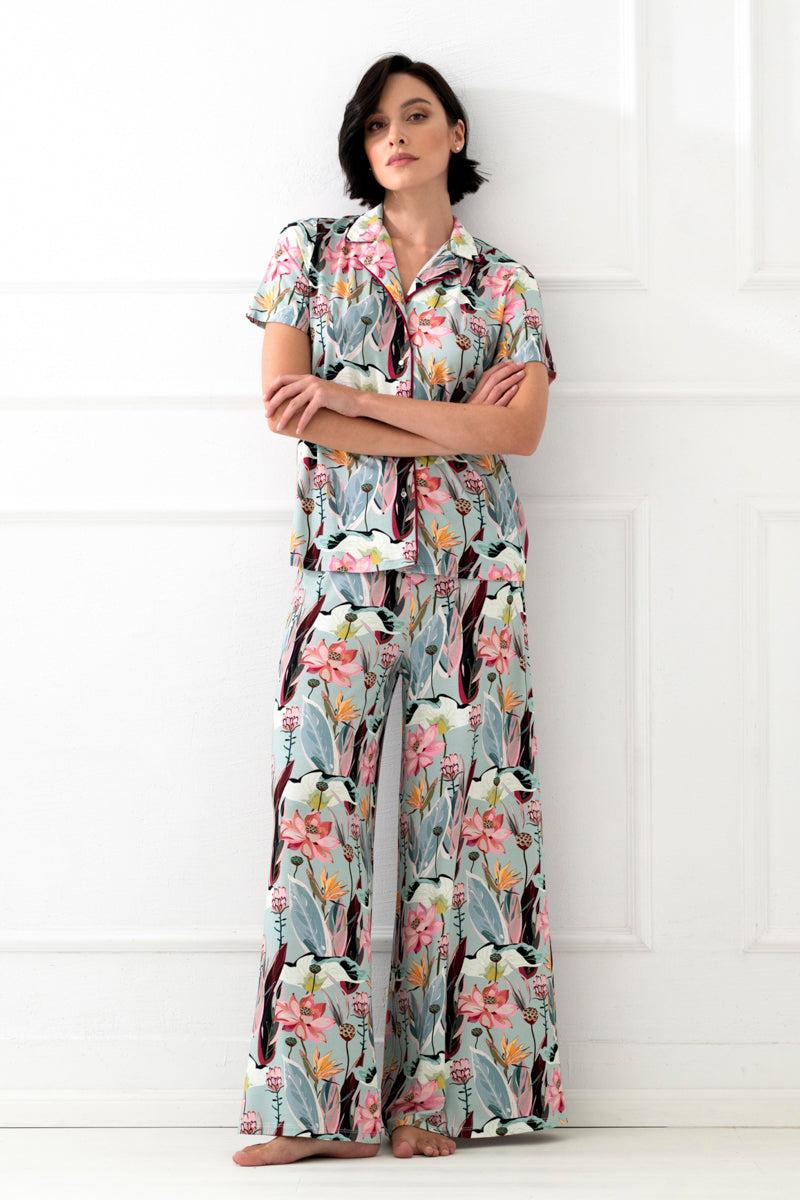
Although they appear similar at first glance – smooth, slightly shiny, and elegant – satin and viscose satin behave completely differently in everyday use. This has a direct impact on whether the buttons on your pajamas will stay firmly in place or start to come loose with movement.
Classic satin (usually polyester) is more slippery and less flexible. If the cut is fitted, the material may not elastically conform to the bust, but rather bend slightly at the fastening line. As a result, micro-gaps appear between the buttons more quickly – especially on fuller figures.
Viscose satin, on the other hand, is softer, more breathable, and drapes better. Viscose naturally conforms to the body's curves and doesn't easily "pull out" at the button placket. This ensures that, with the right size, the closure remains smooth, and the front of the pajama maintains its elegant line even as you change positions during the night.
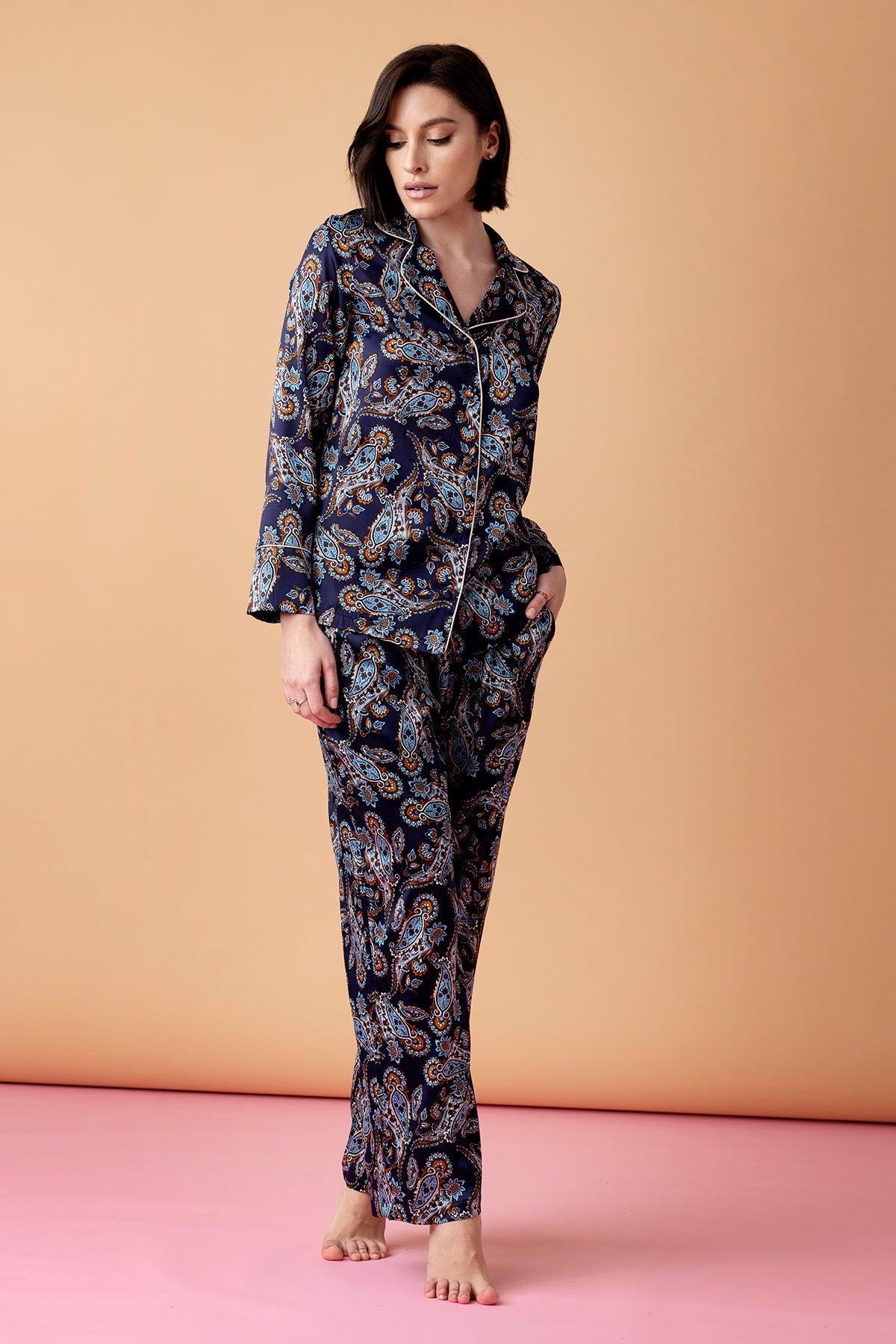
A good example are refined designs like the Oh!Zuza Lullaby Long Silk Pajamas – deep navy blue with a paisley pattern, or the Poem Long Button-Down Pajamas with Lace – red wine . In such designs, not only the fabric but also the front construction and quality of the finish are crucial – this allows the fabric to flow softly around the figure, rather than straining between the buttons.
If you're looking for maximum comfort and natural drape, consider pajamas with viscose as the dominant fabric . This solution combines aesthetics with functionality – and with button-up models, the difference is truly noticeable.
How to check fit before buying and after trying on
Even if the size seems right "on paper," it's worth doing a simple fit test. Button-up pajamas should look good not only when you stand still in front of a mirror, but especially when you move. Movement is often the most obvious way to reveal a lack of room in the bust .
Before purchasing online:
- compare your measurements with the size chart – do not rely solely on the letters S/M/L,
- check the composition – models with a predominance of viscose will fit the figure better,
- pay attention to the cut (simple, classic, slightly fitted).
After fitting, do a short test:
- Raise your arms up – do the buttons stay closed smoothly?
- turn your torso to the side – are there any gaps between the buttons?
- sit down and lean forward slightly – does the front still look aesthetically pleasing?
If the fabric stretches noticeably at any point, consider sizing up. This also applies to elegant styles like the Poem Long Lace Button-Down Pajama Set – Cream , where the subtle details and lace look best when the front remains smooth and unstretched.
Well-chosen pajamas made from quality fabrics and knits don't require constant readjustment. Comfort should be natural and effortless , so you can forget about buttons and simply enjoy a restful night's sleep.
When you hesitate between two sizes – practical tips
This is one of the most common situations: according to the size chart, you're caught between two options. For button-up pajamas, your decision should primarily depend on your bust size and how much freedom you value in the front. If the top is even slightly tight when standing, the buttons will almost certainly start to come loose when moving. Therefore, with button-up styles, it's safer to choose the larger size , especially if you have a fuller bust.
It's also worth considering the effect you're trying to achieve. If you're looking for a more elegant, refined look, choose a classic cut with a slight amount of room. However, if you prioritize maximum comfort while sleeping, a larger size can ensure the fabric drapes more comfortably on your body, without the risk of tension at the buttons.
In well-designed collections, such as those available at Oh!Zuza, a fashionable women's lingerie store , the sizing is carefully considered, and the construction is tailored to a woman's proportions (including a wide range from XS to 4XL). This means that even slightly looser options retain their shape and aesthetic appeal – and this is crucial in sleepwear.
If you're still wondering whether a button-up or another style is a better choice, the comparison described in the article "Button-up Pajamas vs. Classic Nightgowns – What to Choose" may be helpful. Sometimes, changing the design solves the fit problem faster than changing the size.
The most important thing to remember, however, is that well-chosen pajamas shouldn't require compromise . Buttons should be a detail, not a source of discomfort – and the right size and conscious choice of style are key to a restful, comfortable sleep.