Type:
Oh!Zuza Fishnet Socks Set of 2 – Black and Cream


Fishnet ankle socks for everyday and special occasions
Fishnet ankle socks are short, openwork socks with a lace weave, ending above the ankle and serving as jewelry for shoes. In the Oh!Zuza collection, you'll find them in two permanent colors: deep black and soft cream. They are an accessory for the whole year – from summer sandals, through ballet flats and loafers in the transitional season, to high heels for an evening out.
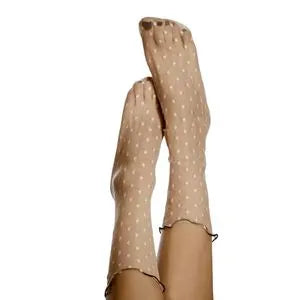
The construction of fishnet socks is based on a lace fabric – a regular, openwork mesh that allows air to pass through and remains translucent on the skin. These are not ordinary socks with added lace on the upper – the entire sock is woven with a lace pattern. Hence the name, which refers to evening "fishnets," although here it only refers to socks, not tights or stockings.
The cream version is called Vanilla Net and has a lighter, warm shade – it looks good with bare legs in summer and with light trousers in winter. The black variant, Lace Mystery, has a more evening character and stands out distinctly on the skin and with lighter footwear. Both versions can be purchased separately or as a set of two pairs.
Fishnet ankle socks fall into the category of elegant women's socks – alongside tulle models, lace footlets, and classic cotton ones. At Oh!Zuza, we treat them as a small wardrobe item that can change the character of an entire outfit, even though it takes up the least space in the wardrobe.
Lace socks – what does lace fabric look like?
The lace socks from this collection are woven from a uniform lace fabric – a repetitive, openwork pattern spread over the entire surface of the sock, from the toes to the top edge. The weave is dense enough for the sock to hold its shape, and open enough for it to remain translucent and airy.
The composition is 85% polyamide and 15% elastane. Polyamide is responsible for the lightness, smoothness, and delicate design of the lace, while elastane provides elasticity and a snug fit to the foot without constriction. Thanks to this proportion, the sock lies smoothly on the ankle without bunching and doesn't leave deep marks after removing the shoe. This is particularly important for footwear models where the foot comes into contact with the material without the intermediary of a thick textile sole.
The upper edge ends with a lace finish, which serves a decorative function and simultaneously stabilizes the sock on the leg. There is no classic, constricting cuff here – the edge remains soft, subtly scalloped, and visible above the shoe line. It is precisely this edge that determines the evening, feminine character of the sock.
The lace pattern is repeated in both color variations – black and cream – so two pairs from the set look like a variant of the same model in two shades, not two different designs. This makes it easier to match them with other women's accessories – such as lace fingerless gloves or hair bands maintained in a similar aesthetic.
Transparent socks for ballet flats and loafers
Transparent lace socks are especially suitable for footwear that shows the ankle and instep: ballet flats, loafers, moccasins, and high heels with an exposed top of the foot. The semi-transparent structure means that the sock does not cover the skin flatly – it creates a delicate pattern that looks like a lace detail of the shoe, rather than an additional layer.
Lace socks for high heels pair well with classic pumps in skin tone, black, or nude. The black version emphasizes the ankle line and visually elongates the foot, while the cream version softens the contrast between a light shoe and the leg. In both cases, the sock should extend two to three centimeters above the shoe line, so that the lace edge is visible. Hiding it under the upper defeats the purpose of the accessory.
Lace socks for ballet flats are the most frequently chosen spring-summer set – ballet flats expose the entire instep and top of the foot, so the lace fills this space without adding bulk. For loafers with a thicker sole and a higher upper, the black version is better suited, as it distinctly stands out above the shoe edge and creates a contrast with smooth leather.
If you're looking for a similar effect in a different texture, our collection also includes tulle socks – with a smoother, mesh structure, without a distinct lace pattern. Fishnet socks have a more expressive pattern and a greater dose of "jewelry-like" quality, while tulle ones are more minimalist.
Do fishnet ankle socks make legs look thicker?
No, fishnet ankle socks do not make legs look thicker. The openwork weave and translucent structure ensure that the sock does not create a solid surface where it ends – and it is precisely a sharp, dense line on the calf that can optically shorten and thicken the leg. Lace blurs this line and transitions smoothly from the shoe to the skin.
The effect is closer to stockings than to classic sports socks. The eye doesn't stop at the edge of the cuff but travels along the lace pattern, which itself is visually lighter than solid fabric. In the cream version, the effect is even more subtle – the light shade blends with lighter skin tones, and the pattern remains a delicate accent, not a block of color.
It also matters that fishnet socks end above the ankle, not in the middle of the calf. Cutting the leg at its narrowest point – just above the ankle bone – is beneficial for the proportions of the styling, regardless of the length of the trousers or skirt. Unlike mid-calf socks, which can indeed visually shorten the leg, fishnet socks work to the advantage of the silhouette.
If the concern is about the visibility of the sock with fitted trousers, it's worth remembering that lace is thin and does not create bulk under the material. The sock fits freely under a classic suit and tight jeans, without showing through the fabric.
How to wash lace socks
Wash lace socks made of polyamide and elastane at a low temperature – up to 30°C – on a delicate cycle or by hand. Place them in a laundry bag so the lace doesn't snag on fasteners of other clothing or on the washing machine drum. Do not use bleach and do not iron.
Dry flat or on a hanger, away from heat sources. Polyamide reacts poorly to high temperatures: hot washing and tumble drying can permanently deform the lace weave and cause the sock to lose elasticity. The same rule applies to radiators – do not place socks directly on a heater.
Use liquid detergents for delicate fabrics, avoiding powdered detergents with granules that can get stuck in the lace eyelets. If the sock is cream-colored, it's best to wash it separately or with whites and beiges – the lace weave easily picks up color from darker fabrics during the first wash.
With proper care, lace socks last many seasons, despite appearing delicate. Polyamide is resistant to friction and does not pill, and elastane returns to its shape after each stretch. Similar rules apply to other delicate accessories – for example, to fingerless gloves made of lace, which at Oh!Zuza we sew from similar fabrics.
FAQ
What is the difference between fishnet ankle socks and fishnet tights?
Fishnet ankle socks are short socks with a lace fabric that end above the ankle, while fishnet tights are long garments covering the entire leg and hips. At Oh!Zuza, we sell only ankle socks – fishnet tights and stockings are not in our offer. The name "fishnet" in both cases refers to the characteristic openwork weave.
What can fishnet ankle socks be worn with?
Fishnet ankle socks are worn with ballet flats, loafers, moccasins, high heels with an exposed instep, and with summer sandals in more daring styles. They work for both everyday and evening wear – the black version has a more formal character, the cream version is more casual. The sock should extend above the shoe line so that the lace edge is visible.
Do fishnet ankle socks make legs look thicker?
They do not make legs look thicker. The openwork, translucent weave does not create a solid line of division on the leg, but gently blurs the boundary between the shoe and the skin. The sock ends above the ankle, which is the narrowest part of the leg, further benefiting the proportions.
Are fishnet ankle socks elegant?
Yes, the lace fabric gives them an evening, feminine character – closer to shoe jewelry than a classic sock. The black version suits formal outfits with high heels and a suit, while the cream version works well with light dresses and skirts. They are an accessory that elevates an everyday outfit without adding excessive detail.
How to wash lace socks?
Wash at a temperature of up to 30°C, on a delicate cycle or by hand, preferably in a laundry bag. Do not iron, bleach, or tumble dry or dry on a radiator. Dry flat or on a hanger at room temperature to maintain the elasticity of the weave.
Are fishnet ankle socks one-size-fits-all?
Fishnet ankle socks have a stretchy, elastic weave with 15% elastane, allowing them to adapt to a wide range of foot sizes. They do not have a constricting cuff, so they do not pinch the leg above the ankle. It is worth checking the detailed size range in the description of a specific model before purchasing.

OWN, LOCAL SEWING WORKSHOP

SUSTAINABLE MATERIALS

RESPONSIBLE PRODUCTION

FAMILY COMPANY

100% POLISH PRODUCTION